Luzmo's AI features, including chart and dashboard agents and Luzmo AI, are not trained on customer datasets. Luzmo logs
conversations for the duration of our regular log retention window to help with issue investigations and product
quality. Conversations can also be retrieved via the Conversations API for usage analytics or to show history in your
app.
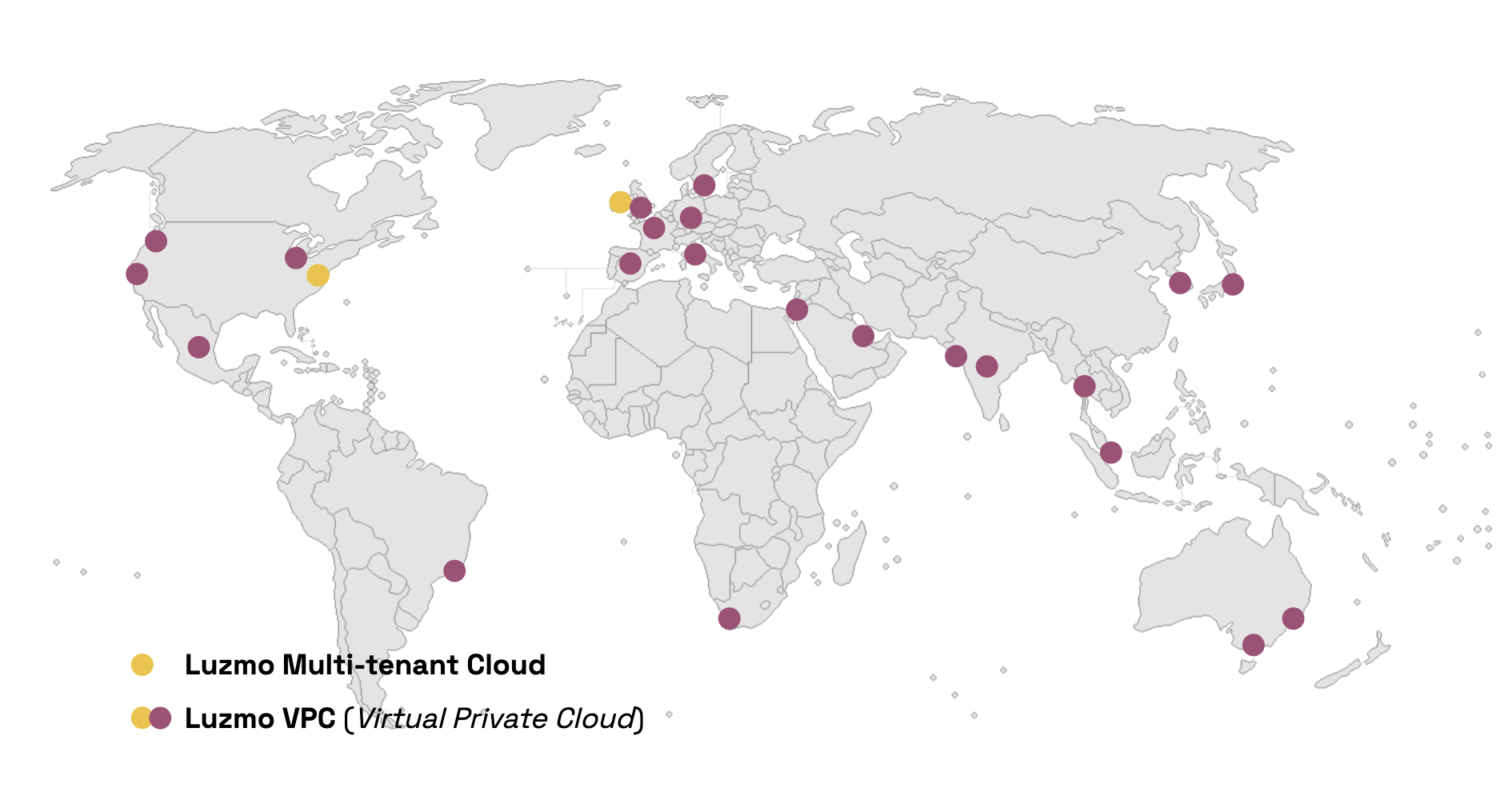
Luzmo uses OpenAI for inference, with data residency matching the Luzmo multi-tenant or dedicated cloud tenancy. Luzmo
has a zero data retention (ZDR) agreement with OpenAI: prompts and completions are not
stored by OpenAI, and are not used to train models. OpenAI is listed as a subprocessor on this Trust Center and in our
Data Processing Agreement.
What the model receives depends on the feature. Lookups and queries run in Luzmo's Query Engine, under the viewer's
access control, outside the model.
Metadata only: column and dataset descriptions, metadata suggestions, and formula generation. The model
sees names, types and descriptions. No cell values and no query results.
Category values: chart generation and dashboard creation. The model receives a sample of distinct
values from category columns, and further lookups when a filter needs an exact value. Those values can include personal
data. It does not receive measure results or the chart's query output.
Query results: AI summaries, Luzmo AI, and Luzmo AI agentic APIs and MCP. The model receives the query
result, which may include personal data. Results are aggregated unless the chart or question is a row listing. Category
values may also be looked up, or embedded, to match a filter or a classification. Because aggregation results (for
example โtop 10 customers by spendโ) can contain PII, we treat our AI inference providers as data subprocessors.